Exploring the realm of Admiralty Law in the US, this introduction sets the stage for a fascinating journey into the intricate world of maritime legal cases. With a blend of informative insights and captivating narratives, readers are invited to uncover the nuances of Admiralty Law and its significance in the legal landscape.
The subsequent paragraph delves deeper into the specifics of cases falling under Admiralty Law, shedding light on its jurisdictional aspects and distinguishing features from other legal domains.
What is Admiralty Law in the US?
Admiralty Law, also known as maritime law, is a body of law that governs legal matters involving navigable waters. It deals with both domestic and international issues related to shipping, sailors, navigation, and marine commerce.
Origins and Development of Admiralty Law
Admiralty Law has its roots in ancient maritime customs and practices. Over time, it has evolved into a complex legal system that addresses various aspects of maritime activities. The development of Admiralty Law in the US can be traced back to the Constitution, which grants federal courts jurisdiction over admiralty and maritime cases.
Examples of Maritime Cases Under Admiralty Law
- Collisions at sea: When ships collide, causing damage or injury, Admiralty Law governs the legal implications and liabilities.
- Salvage operations: Legal issues related to the recovery of ships or cargo at sea fall under Admiralty Law.
- Maritime contracts: Contracts related to shipping, charter parties, and carriage of goods by sea are subject to Admiralty Law.
- Maritime liens: Claims against a vessel or its cargo for debts or damages are regulated by Admiralty Law.
Types of Cases Covered by Admiralty Law
Admiralty Law in the US covers a wide range of cases involving maritime activities and disputes that occur on navigable waters. These cases are unique in nature and fall under federal jurisdiction due to the specialized legal framework governing them.
Types of Admiralty Law Cases
- Maritime Contracts: Cases involving contracts related to maritime activities such as shipping agreements, charter parties, and salvage contracts.
- Maritime Torts: Cases dealing with personal injury or property damage that occurs at sea or on navigable waters.
- Maritime Liens: Cases regarding the enforcement of liens on vessels or maritime property for unpaid debts.
- Salvage and Towage: Cases involving the recovery or towing of ships or cargo at sea.
Jurisdictional Aspects of Admiralty Law
Admiralty Law grants federal courts exclusive jurisdiction over maritime cases to ensure consistency in applying maritime laws across the US. This jurisdiction extends to cases involving vessels, cargo, maritime contracts, and other related disputes.
Comparison to Other Legal Cases
Admiralty Law differs from traditional legal cases in that it follows a distinct set of rules and procedures tailored to maritime activities. Unlike general civil or criminal cases, Admiralty Law cases often involve international aspects and unique legal principles specific to maritime commerce and navigation.
Key Principles of Admiralty Law
Admiralty Law, also known as maritime law, is a specialized area of law that governs maritime activities and disputes
Fundamental Principles of Admiralty Law
- Admiralty law is based on the principle of uniformity, aiming to provide consistent rules and regulations across different maritime activities and jurisdictions.
- It is heavily influenced by international treaties and conventions, as maritime activities often involve multiple countries and international waters.
- Admiralty law prioritizes the safety and efficiency of maritime commerce, as well as the protection of marine environment and resources.
- It allows for unique remedies and procedures, such as maritime liens, salvage, and general average, to address specific issues that arise in maritime disputes.
Role of Federal Courts in Admiralty Cases
Admiralty cases fall under the jurisdiction of federal courts in the United States due to the federal government's authority over maritime activities and interstate commerce. Federal courts have exclusive jurisdiction over admiralty cases, ensuring uniformity and consistency in the application of admiralty law.
Admiralty Law and International Treaties
Admiralty Law in the US is heavily influenced by international treaties and conventions that govern maritime activities on a global scale. These treaties play a crucial role in shaping Admiralty Law by providing guidelines and standards that ensure consistency in maritime practices across different nations.
Impact of International Treaties on Admiralty Law
International treaties serve as the foundation for many principles and regulations found in Admiralty Law. For example, the United Nations Convention on the Law of the Sea (UNCLOS) is a key treaty that establishes rules for the use of the world's oceans and resources.
This treaty has influenced various aspects of Admiralty Law, such as jurisdiction, navigation rights, and environmental protection.
- UNCLOS defines the rights and responsibilities of nations in their use of the world's oceans, including territorial waters, exclusive economic zones, and the high seas.
- The treaty also addresses issues related to marine pollution, conservation of marine resources, and the settlement of disputes between nations regarding maritime boundaries.
- UNCLOS has been instrumental in shaping Admiralty Law in the US by providing a framework for resolving conflicts and promoting cooperation among nations in maritime matters.
Landmark Cases and International Treaties
International treaties have played a significant role in several landmark cases in Admiralty Law. One notable example is the case of The Paquete Habana, where the US Supreme Court considered the impact of customary international law, including treaties, on the rights of foreign vessels in US waters.
International treaties not only influence national laws but also shape the interpretation and application of Admiralty Law in cross-border maritime disputes.
Final Conclusion
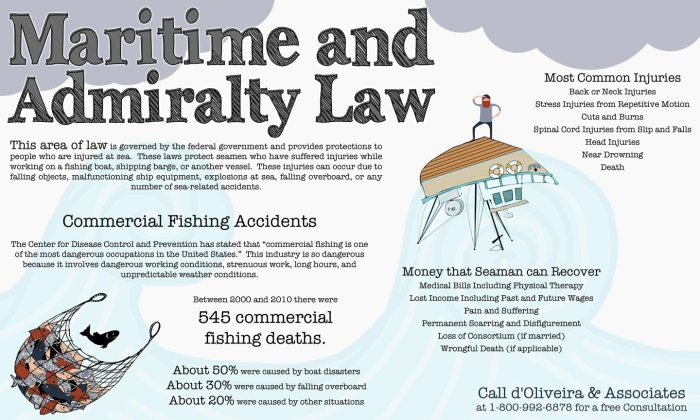
As we conclude our discussion on cases falling under Admiralty Law in the US, a comprehensive summary encapsulates the key takeaways and highlights the importance of understanding this specialized area of law.
Helpful Answers
What types of cases are typically covered by Admiralty Law?
Admiralty Law typically covers cases related to maritime activities, such as collisions at sea, cargo disputes, and salvage operations.
How does Admiralty Law differ from traditional civil law?
Admiralty Law focuses specifically on maritime issues and is governed by a distinct set of rules and regulations tailored to the unique challenges of the sea. In contrast, traditional civil law deals with a broader range of legal matters.
What role do federal courts play in adjudicating Admiralty cases?
Federal courts have jurisdiction over most Admiralty cases in the US, ensuring uniformity in the application of maritime laws and providing a specialized forum for resolving maritime disputes.